
After defending his PhD on November 18, 2025, the dust has finally settled. With the intensity of the defense behind him, we recently had the chance to sit down with Mridul Bhattarai to reflect on his PhD journey at CVIT—what challenged him, what shaped his growth, and what comes next.
What were some of the biggest technical or scientific challenges you encountered during your project?
One of the biggest challenges was the DukeCounter (virtual PCCT) project. The detector responses generated by the model matched well with findings in the literature, but the reconstructed CT images did not align with outputs from real scanners. Troubleshooting that discrepancy was particularly difficult and time-consuming.
Another major challenge came from the energy-setting optimization and quad-energy imaging work. I needed to simulate many energy settings across multiple scanners, which would have been extremely slow using DukeSim’s existing pipeline. To address this, I essentially restructured DukeSim for more efficient simulation. I am genuinely proud of that work—not only because of the results, but because of how I approached and solved the problem.
In what ways do you think your research contributes to the broader field of medical imaging or respiratory health?
Again, DukeCounter stands out. It is already being used by external collaborators, which is incredibly rewarding. The framework supports system and protocol design, task-based optimization, image harmonization, and large-scale multi-energy data generation, especially in settings where access to PCCT scanners is limited.
Photon-counting CT is the future of x-ray-based medical imaging, so contributing to its development at an early stage feels particularly meaningful.
Were there specific collaborations or CVIT projects that had a significant impact on your research or personal growth?
When I began working with Monte Carlo simulations and analytical modeling, I had opportunities to interact with pioneers in x-ray imaging, CT physics, and photon-counting detectors—from both academia and industry. Those conversations indirectly shaped the development of DukeCounter.
I still remember chatting with Mats Persson at SPIE and asking how to best use the scanner model we had built. His answer was simple: generate data for large language models. That idea stayed with me. I later brought it up with my advisor, Dr. Ehsan Samei, and that discussion eventually led to the inter-scanner harmonization project, which became my final dissertation work.
The DukeCounter project also played a direct role in helping me secure an internship at the FDA, where they were looking for someone with detector modeling and Monte Carlo experience.
How did you grow professionally and personally during your PhD?
I learned how to talk to people—scientists, collaborators, industry partners, radiologists, undergraduate students. I learned how to learn, how to think, and how to find and define meaningful projects. Science is the foundation, but many equally important skills sit on top of it.
During my PhD, I learned (and am still learning) how to develop those skills so I can grow not just as a scientist, but also as a researcher, engineer, listener, learner, and eventually, a leader.
Can you share a moment or lesson from your mentors that really stayed with you?
Yes—when Dr. Samei asked me if I was ready to defend. Internally, I was jumping with excitement. Outwardly, I stayed calm, smiled, and said yes.
There were countless lessons from the mentors in our lab, both scientific and beyond. I hope I can carry all of that forward—time will tell how well I succeed.
What did being part of the CVIT community mean to you, both in terms of work and friendships?
CVIT shaped my professional identity, and in many ways, it will stay with me. The way I think about medical imaging, the application of AI, research, and collaboration all comes directly from my time here.
In terms of friendships, I made many meaningful connections—people I may not see every day, but people I truly consider friends as we grow in our careers and lives.
Are there any standout memories from your PhD that you will never forget? Any funny experiences you would like to share?
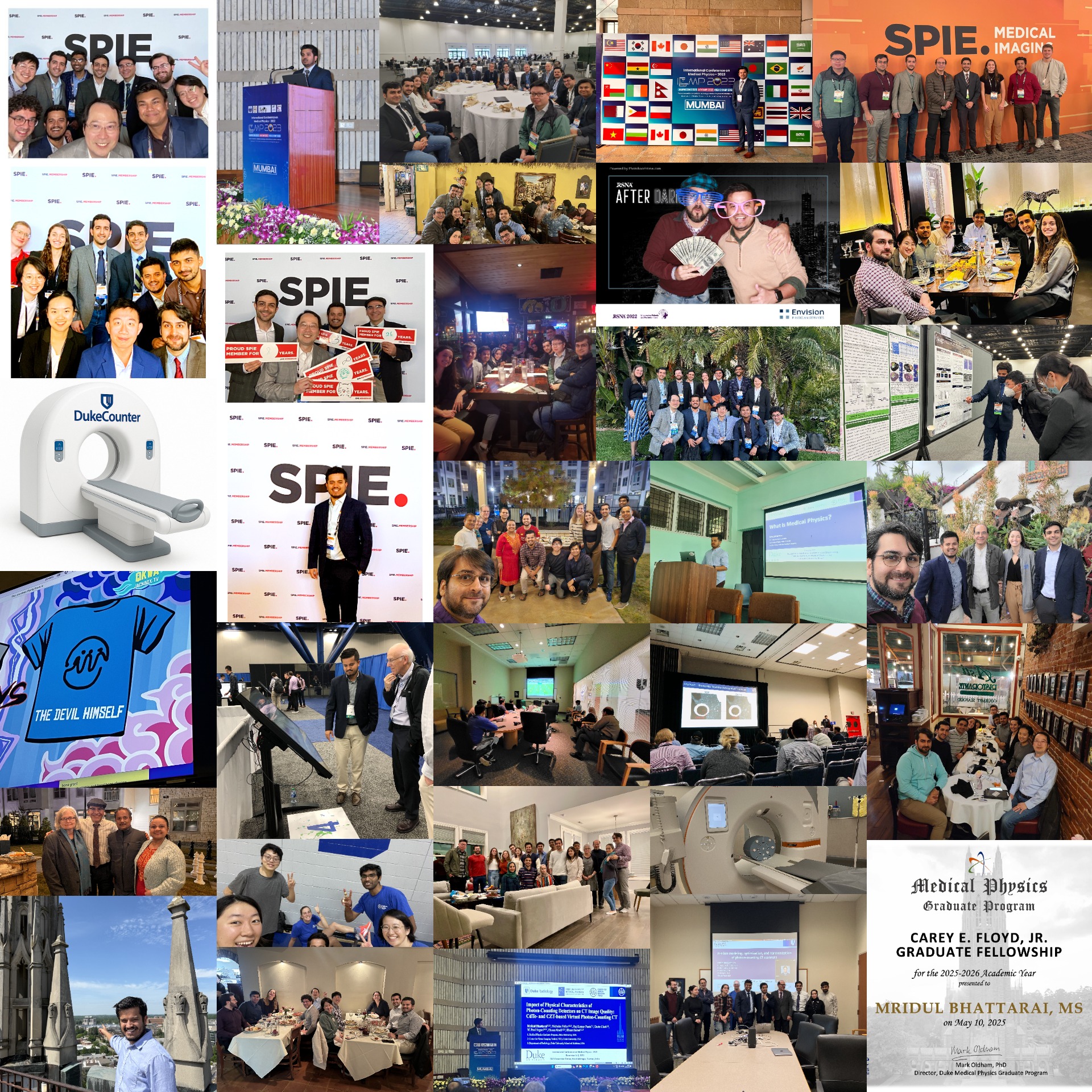
SPIE post conference parties (amazing!!!). Duke has a lively social side, and the CVIT experience is no different—conference gatherings were fun, memorable, and a great way to connect with colleagues. AAPM in Houston was amazing too. There was this bar with an actual indoor futsal court. I had never seen something like that. Soccer and alcohol, not a great combination, but then, it was great.So many great memories with CVIT friends in conferences. Always.
What are your next steps after graduating?
I have started a postdoctoral position with Dr. Ehsan Abadi. I am looking forward to learning as much as I can during this phase and seeing where it leads in the longer term.
How do you envision using the skills and insights from your PhD in your future career?
I see the PhD as training in how to think, rather than what to know. The ability to learn independently, adapt, formulate plans, and connect physics with clinical needs will directly carry into my future career—whether that involves imaging systems, AI-driven methods, or product development. Problem formulation and translating real-world questions into solvable technical challenges are skills I will continue to rely on.
What advice would you give to new PhD students just starting out?
During a PhD, you have mentors to help when needed, but much of the process involves figuring things out on your own. Be open to learning and exploring—and most importantly, enjoy the process.
We thank Mridul for all the dedication, creativity, and thoughtfulness he brought to CVIT throughout his PhD. We are grateful for his many contributions to the lab and are excited to have him with us a bit longer as he begins the next chapter of his career.
