
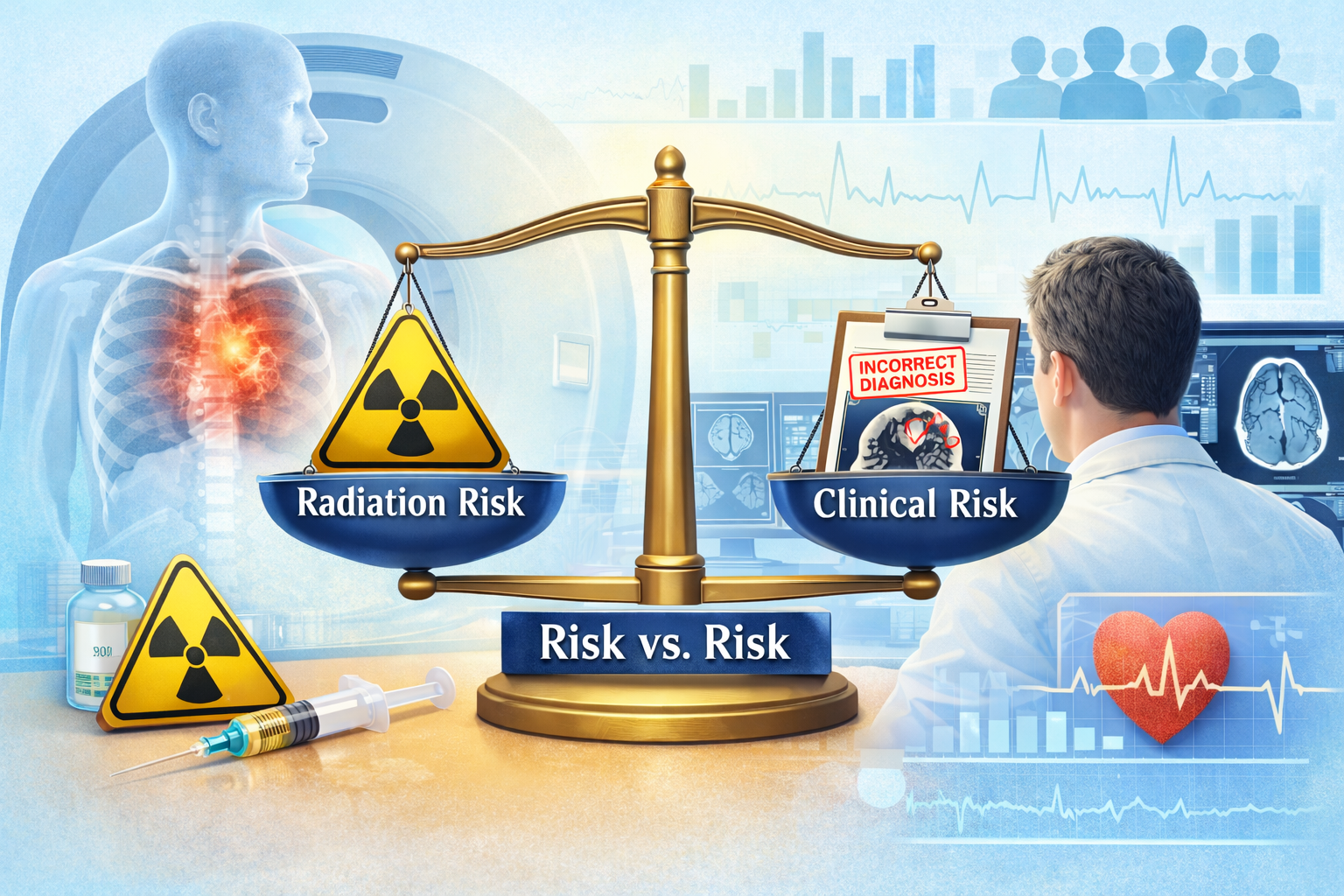
A recent study from CVIT and CIPG was featured in Radiological Society of North America (RSNA) News. Researchers led by Francesco Ria and Ehsan Samei developed a novel total risk index that integrates multiple factors, including patient demographics, disease prevalence, expected life-years lost due to incorrect diagnoses, and radiologist interpretative accuracy (AUC), to more comprehensively evaluate imaging strategies.
The model was applied to a simulated cohort of one million “digital twin” patients constructed from real-world clinical data. The study highlights that advances in radiology should simultaneously consider both the risks and benefits to patients. However, direct comparisons between risk and benefit are challenging, as they are typically measured and communicated using different metrics and units.
To address this challenge, the proposed framework reframes risk–benefit assessment as a risk-versus-risk comparison, contrasting the radiation-induced risk from imaging with the clinical risk associated with potential misdiagnosis. Simulation results demonstrate that, at typical CT examination dose levels, clinical risk substantially outweighs radiation risk. Importantly, the findings emphasize that radiation dose reduction efforts should not come at the expense of diagnostic quality and patient care.
Ultimately, the work reinforces a central principle of modern radiology: optimizing patient care requires balancing radiation risk without compromising diagnostic performance.
